
Centre for Stem Cell Research
A unit of BRIC - inStem, Bengaluru, Christian Medical College Campus, Bagayam Vellore

Adjunct Scientist
Organoid Lab Lab-04
Centre for Stem Cell Research,
Christian Medical College,
Vellore.
Office: +91 416 228 5118
Lab: +91 416 228 5117
Email: b.vijayalekshmi@cmcvellore.ac.in
Career Interest
- Innate immune activation in liver diseases, with a focus on alcoholic liver disease and drug-induced liver injury (including yellow phosphorus/rodenticide poisoning)
- Disease modelling using human intestinal and liver organoids
- Immune–tissue interactions in intestinal and hepatic systems
- Micronutrients and inflammation in maternal and child health
Education
- M.D. in Biochemistry, All India Institute of Medical Sciences, New Delhi (2016)
- M.B.B.S., Kasturba Medical College, Manipal University, Mangalore (2012)
Awards & Honors
- 2025 – ANRF Travel Grant for attending EMBO Organoid Conference
- 2024 – Third Prize, Oral Presentation, Annual Research Day, CMC Vellore
- 2024 – Junior Training Fellowship, CMC Vellore (Liver Organoids Training, Erasmus Medical Center)
- 2023 – Travel Bursary, Wellcome Connecting Science, UK (Organoid Disease Models Workshop)
- 2015 – Certificate of Excellence, Best Journal Club of the Year, AIIMS New Delhi
Our laboratory develops and applies human intestinal and liver organoid platforms to study disease mechanisms, with a strong focus on innate immune activation, inflammation, and metabolic disease. We develop well-characterized human organoid biobanks and use these systems to investigate epithelial biology in both health and disease, with an emphasis on translational relevance.
1. Liver organoids 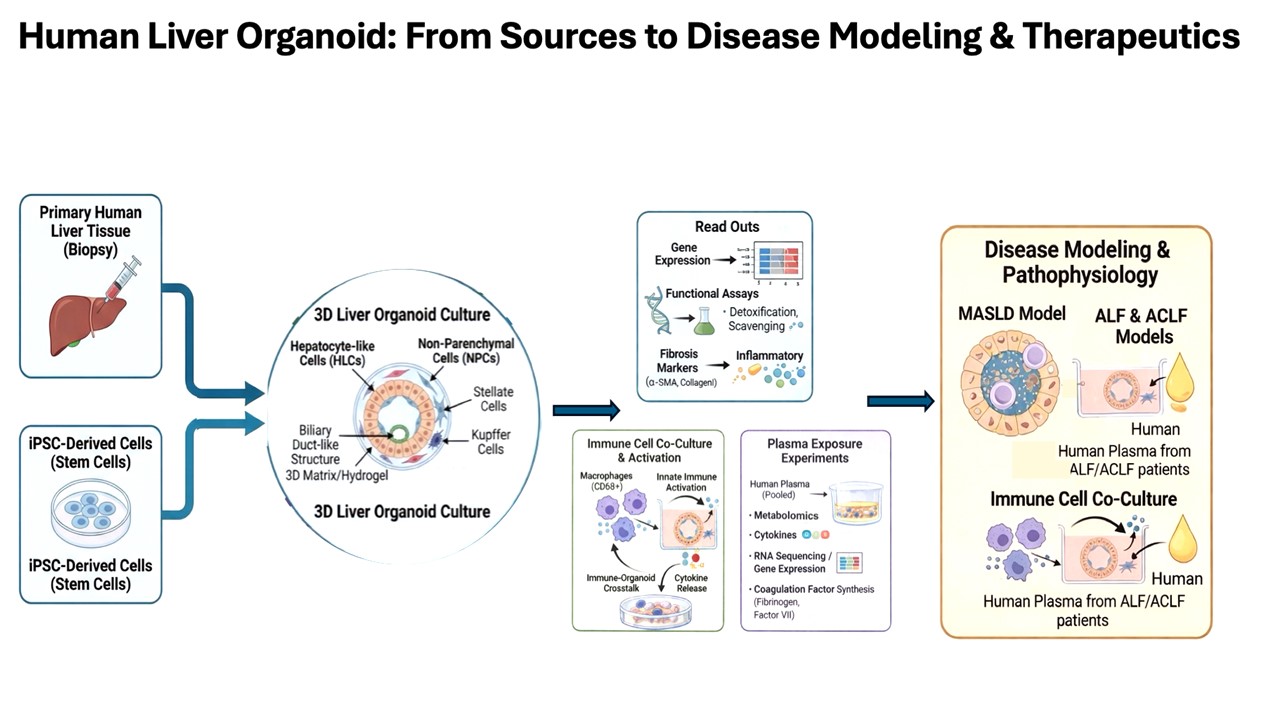
We have successfully developed a human liver organoid utilizing tissue obtained from individuals undergoing surgery for non-hepatic reasons. Our current endeavors are concentrated on the comprehensive characterization, quality control, and reproducibility of this organoid to establish a dependable resource for disease modeling.
A significant focus of our research is to elucidate the role of non-parenchymal cells in liver biology and pathology. We examine how these cell populations contribute to inflammation, tissue remodeling, and immune responses within the hepatic microenvironment. Our investigations include core liver functions in organoid systems, such as responses to plasma-derived factors, synthesis of coagulation factors, and metabolic stress. These assessments provide functional benchmarks for evaluating liver organoid maturity and disease relevance. We are establishing Metabolic Dysfunction-Associated Steatotic Liver Disease (MASLD) models using liver organoids derived from healthy donors and are working toward direct comparison with organoids generated from patients with MASLD to define disease-specific phenotypes and mechanisms.
To enhance genetic and phenotypic diversity, we are developing induced pluripotent stem cell (iPSC)-derived liver organoid systems. These models will complement organoids derived from primary tissue and facilitate scalable, patient-specific disease modeling. Additionally, we are constructing co-culture platforms, particularly with macrophages, to investigate innate immune activation and inflammatory liver injury in MASLD and alcohol-related liver disease.
2. Intestinal Organoids (Enteroids)
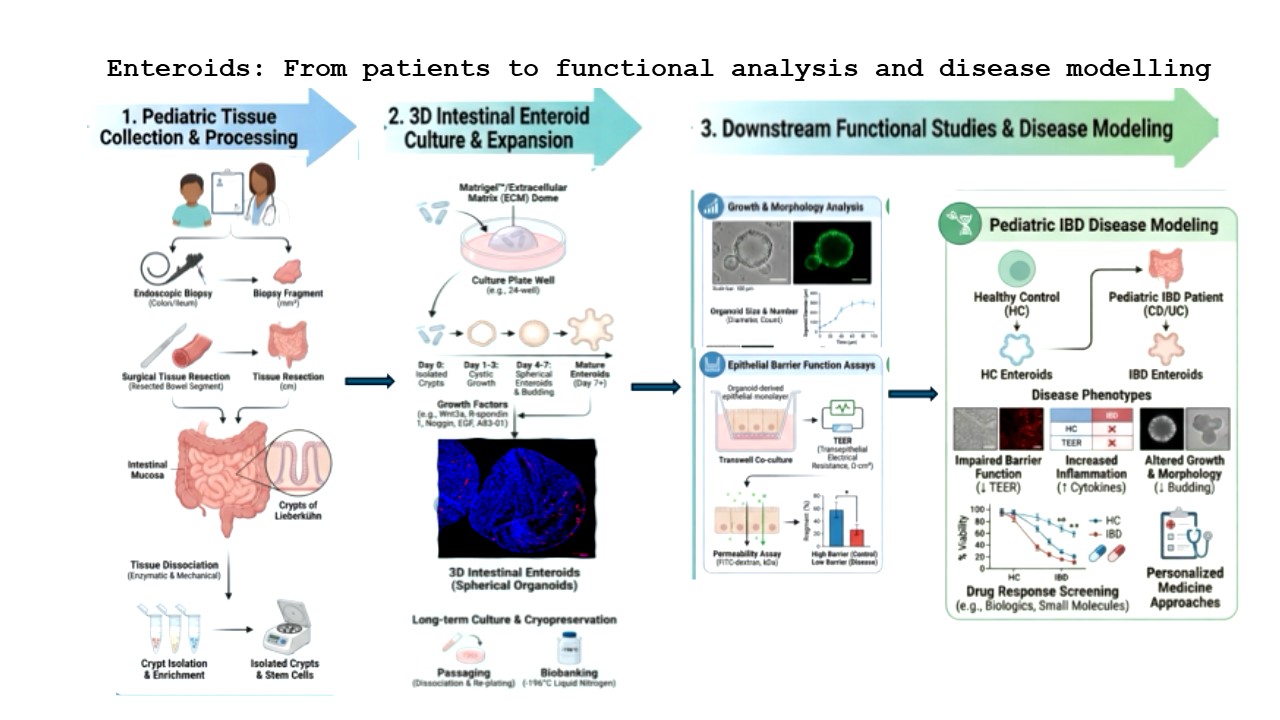
We employ a pediatric intestinal organoid biobank derived from biopsies and surgical tissues collected from children under five years of age. These patient-derived enteroids are systematically characterized and provide a robust human platform for modeling gastrointestinal disease. Our research focuses on very early onset inflammatory bowel disease (VEO-IBD), utilizing intestinal organoids to examine disease-associated changes in epithelial growth, morphology, and barrier function. This methodology facilitates functional, disease-relevant investigation of epithelial defects within a controlled human system. We explore how inflammatory stimuli affect epithelial organization, differentiation, and barrier integrity. By integrating biobanking, phenotypic characterization, and functional assays, our intestinal organoid systems offer reproducible platforms for studying inflammatory and infectious intestinal diseases and for evaluating therapeutic strategies.

- Pregnancy Risk, Infant Surveillance, and Measurement Alliance (PRISMA) Investigators. Pregnancy Risk, Infant Surveillance, and Measurement Alliance (PRISMA) Maternal and Newborn Health Study: protocol for a multisite, prospective, open cohort study of pregnancy and postpartum health outcomes in South Asia and sub-Saharan Africa. BMJ Open. 2026 Jan 20;16(1):e104512. doi: 10.1136/bmjopen-2025-104512. PMID: 41558748; PMCID: PMC12820853.
- Vijayalekshmi Balakrishnan, Bhuvaneswari Selvam, Sandya Rani B et al. Paediatric Intestinal Enteroids Derived from Very Early Onset Inflammatory Bowel Disease Reveal Differences in Growth, Morphology, and Barrier Function, 13 November 2025, PREPRINT (Version 1) available at Research Square [https://doi.org/10.21203/rs.3.rs-8034357/v1]
- Vijayalekshmi B, Chaudhary A, Prabhu SB, Sharma A, Balasubramanian KA, Zachariah U, et al. Plasma-Driven Monocyte Dysfunction Drives Disease Progression in Alcohol-Related Acute-on-Chronic Liver Failure. J Gastroenterol Hepatol [Internet]. [cited 2025 Aug 11];n/a(n/a). Available from: https://onlinelibrary.wiley.com/doi/abs/10.1111/jgh.70053
- Smith ER, Hoodbhoy Z, Hotwani A, Jehan F, Khan A, Nisar I, et al. Protocol for the Redefining Maternal Anemia in Pregnancy and Postpartum (ReMAPP) study: A multisite, international, population-based cohort study to establish global hemoglobin thresholds for maternal anemia. PLOS ONE. 2025 July 28;20(7):e0321943.
- Zachariah U, Vijayalekshmi B, Matthai SM, Goel A, Eapen CE. Extra-corporeal non-liver transplant therapies for acute liver failure: Focus on plasma exchange and continuous renal replacement therapy. Indian J Gastroenterol. 2024 Apr 1;43(2):338–48.
- Balakrishnan V, Kodiatte T, Amirtharaj G, Christudoss P, Zachariah U, Jose A, et al. Rhodanine Stain Improves Utility of Leipzig Score to Diagnose Hepatic Wilson’s Disease in Noncholestatic Patients with Fibrosis. Gastroenterol Hepatol Endosc Pract. 2023 Dec 28;4:22–7.
- Chaudhary A, Boddu D, Christal J, Balakrishnan V, Kumar A, Syed C, et al. Early phenotypic and soluble markers of T cell activity can distinguish sepsis associated HLH from sepsis in children. 2024.
- Aaron R, Premkumar K, Chapla A, Vijayalekshmi B, Zachariah U, Elias E, et al. Focused panel sequencing points to genetic predisposition in non-cirrhotic intrahepatic portal hypertension patients in India. Indian J Gastroenterol. 2024 Apr 1;43(2):434–42.
- Ansari S, Mudassir M, Balakrishnan V, Chattopadhyay P. Targeting CXCR4-expressing Cancer Cells with Avidin-poly (lactic-co-glycolic acid) Nanoparticle Surface Modified with Biotinylated DV1 Peptide. Int J Appl Basic Med Res. 2023 July 17;13:106.
- Vijayalekshmi B, Choudhary A, Alexander V, Prabhu SB, Sharma A, Balasubramanian KA, et al. Reticuloendothelial activation and phenotypic alteration of peripheral monocytes with enhanced liver recruitment drive liver injury secondary to yellow phosphorus. J Gastroenterol Hepatol . 2023 Apr
- Thomas L, Chandran J, Goel A, Jacob E, Chacko B, Subramani K, et al. Improving Transplant-free Survival With Low-volume Plasma Exchange to Treat Children With Rodenticide Induced Hepatotoxicity. J Clin Exp Hepatol. 2022 Nov;
- Chatterjee K, Dutta A, Goel A, Aaron R, Balakrishnan V, Thomas A, et al. Common polymorphisms of protein tyrosine phosphate non-receptor type 2 gene are not associated with risk of Crohn’s disease in Indian. World J Gastrointest Pathophysiol. 2022 July 22;13:114–23.
- Kumar SE, Goel A, Zachariah U, Nair SC, David VG, Varughese S, et al. Low Volume Plasma Exchange and Low Dose Steroid Improve Survival in Patients With Alcohol-Related Acute on Chronic Liver Failure and Severe Alcoholic Hepatitis - Preliminary Experience. J Clin Exp Hepatol. 2022 Mar;12(2):372–8.
- Thomas VV, Kumar SE, Alexander V, Nadaraj A, Vijayalekshmi B, Prabhu S, et al. Plasma Von Willebrand Factor Levels Predict Survival in COVID-19 Patients Across the Entire Spectrum of Disease Severity. Indian J Hematol Blood Transfus. 2021;
- Vijayalekshmi B, Sharma A, Prabhu SB, Nair SC, Mammen J, Goel A, et al. Reticuloendothelial activation correlates with disease severity and predicts mortality in severe alcoholic hepatitis. Eur J Gastroenterol Hepatol. 2021 Dec;33(1S Suppl 1):e329–34.
- Jaleel R, Sharma A, Selvaraj V, Aaron R, Muliyil J, Vijayalekshmi B, et al. Dynamic Scoring of Appetite Predicts Inpatient Survival in Patients with Acute-on-Chronic Liver Failure. Gastroenterol Hepatol Endosc Pract. 2021;1(4):143–7.
- Sen M, Vijayalekshmi B, Sharma A, Zachariah UG, Eapen CE, Anand Z, et al. Profile ofpatients with rodenticide poisoning and pictorial confirmation of rodenticideas quick means of identification: A study inatertiary level Hospital. J Forensic Med Toxicol. 2019;36(2):30–5.
- Sardar D, Mathews N, Mammen J, Nair SC, Jacob S, Patel L, et al. Rodenticidal hepatotoxicity: Raised plasma Von Willebrand factor levels predict in-hospital survival and preliminary report of the outcome of Von Willebrand factor reducing management protocol. Indian J Gastroenterol. 2019 Dec;38(6):527–33.
⦁ Dr. Mohankumar, Centre for Stem Cell Research (CSCR)
⦁ Dr. Gurubind Singh, Centre for Stem Cell Research (CSCR)
⦁ Dr Sandya Rani, Centre for Stem Cell Research (CSCR)
⦁ Dr Sitara S R Ajjampur, WTRL, Christian Medical College, Vellore
⦁ Dr. C. E. Eapen, Department of Hepatology, Christian Medical College, Vellore
⦁ Dr. Ashish Goel, Department of Hepatology, Christian Medical College, Vellore
⦁ Dr. Amit K. Dutta, Department of Gastroenterology, Christian Medical College, Vellore
⦁ Dr. Philip Joseph, Department of Hepatobiliary Surgery, Christian Medical College, Vellore